Therapy Room – Episode 16: He Stops Moving at 2:26 A.M.
DATE:AUG 1 2023
Session Type: In-Person
Patient: Male
Introduction — The Minute That Divides the Night
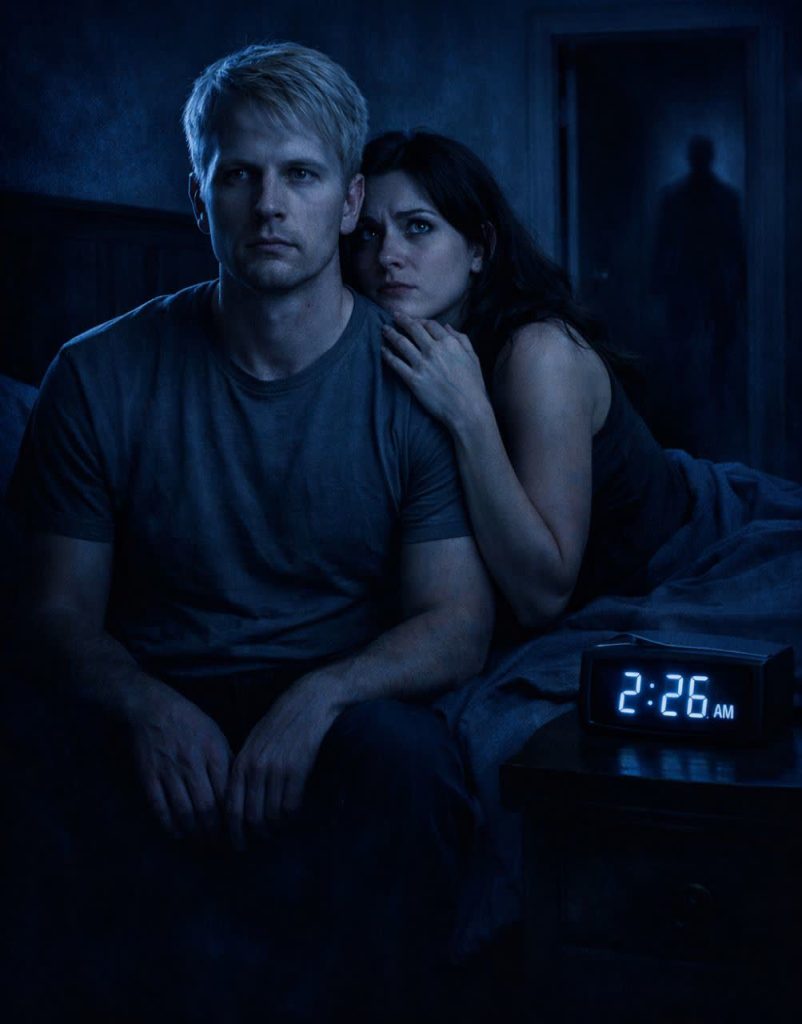
There are disturbances in sleep that can be measured, charted, categorized, and ultimately explained within the reassuring vocabulary of neurology and psychiatry; fluctuations in REM cycles, stress-induced awakenings, parasomnias that wax and wane with hormonal shifts or environmental triggers. And then there are interruptions that resist classification, not because they are dramatic, but because they are precise. This case concerns a man who does not merely wake at 2:26 a.m.; he becomes subject to that minute in a manner so consistent, so mechanically faithful, that the repetition itself becomes the most unsettling element of the phenomenon. For nine consecutive months, regardless of stress levels, travel, illness, or altered sleep schedules, at exactly 2:26 a.m., his body ceases voluntary movement while his consciousness remains intact, alert, and aware of the room around him. The event does not drift across time. It does not hesitate. It does not misfire. It arrives. And when it does, something in the atmosphere of the room alters in ways he struggles to articulate without sounding irrational.
Patient Overview — A Pattern Without Variation
R.A., thirty-eight years old, software engineer, cognitively intact, emotionally regulated, with no psychiatric or neurological history of note, was referred to me by his wife, whose account of the phenomenon was notable not for hysteria but for restraint, as if she feared that exaggeration would reduce the credibility of what she had witnessed repeatedly. She described nights in which she would wake for ordinary reasons — thirst, a distant sound, the quiet instinctive awareness that sometimes surfaces in the early hours — and find her husband sitting upright in bed with an unnatural exactness in his posture, his spine straight, his hands resting without tremor, his eyes open and directed toward the bedroom door with a stillness that felt less like sleep and more like compliance. She would speak his name and receive no answer, touch his shoulder and encounter neither rigidity nor limpness, but a neutral suspension, as though his body had entered a state of deliberate pause rather than involuntary paralysis. After approximately two minutes — sometimes slightly longer — he would blink, inhale more deeply, and ask why she was awake, with full recall of the event and no confusion regarding time or place. He was not absent. He was present. And yet, for that interval, he did not move.
Session One — Conscious Stillness
When I asked him to describe the experience from within, he spoke slowly, not searching for drama but for accuracy, as though the precision of language might protect him from misinterpretation. He explained that the shift begins subtly, several seconds before 2:26 a.m., with a change in the quality of silence inside the house — a compression of background noise, a sense that distant mechanical sounds withdraw slightly, as though the acoustic texture of the environment has thinned. The air, he said, feels denser. Not heavier in weight, but heavier in presence. Then, without warning, his ability to initiate movement ceases, not because he is asleep and not because he is frightened, but because something in him recognizes that movement would be a violation of an unspoken rule. “I’m not frozen,” he told me. “I’m complying.” That distinction, delivered without irony, reframed the entire case.
Session One — Conscious Stillness
Read the Full Therapy Session
Gain access to all episodes, uncensored therapist notes, and classified conclusions.
Become VIPThis content is restricted to subscribers
therapist s personal notes
Professional boundaries demand skepticism, and I maintain it. Yet I would be disingenuous if I claimed that prolonged engagement with this case has not influenced my own perception of that particular minute. Several nights ago, I remained awake intentionally, observing my own anticipatory bias as the clock approached 2:26 a.m., fully aware of the power of suggestion and the mind’s capacity to generate somatic responses. When the minute arrived, there was no dramatic event, no shadow crossing the wall, no auditory anomaly that could not be rationalized. And yet, the room felt briefly asymmetrical, as though the distribution of space had shifted by a fraction too small to measure but large enough to sense. For approximately four seconds, I experienced an impulse — subtle but clear — to remain absolutely motionless. Not out of fear. Out of instruction. The impulse faded. The air normalized. The clock advanced. But the awareness remained.